2026-11-22 · JevGym
I ran the same prompt five times and 26 questions changed their answers
Measuring the noise floor, and why it changed how I decide one prompt beats another.
I previously guessed that rerunning the same prompt would move the score by less than a point. I ran it five times and the score moved by 0.5 points: from 85.3% to 85.8%.
What I didn’t expect was how many individual answers would change. 26 of the 1,000 questions got a different answer in at least one of the five runs. I thought that would stay below 1%.
Below I look at where that wobble comes from and how it compares to the Wilson interval from the last post. It also made me change the rule I use to decide that one prompt beats another.
Why rerun a prompt that hasn’t changed?
Soon I’ll be comparing prompts against each other. If the Hand-written prompt scores 0.3 points above Minimal, is that the prompt or just luck? I can’t tell without knowing how much a single prompt moves on its own.
That amount is the noise floor. It’s the spread you get from running the exact same thing again. I treat any gap within it as noise.
Five identical runs
I ran the Minimal prompt from the last post five more times on the same 1,000 Dev questions. The config, the data and the model version (jev-1.14.0) were the same every time. Jev’s API has no seed or temperature setting, so whatever varies is happening on Jev’s side, not mine. The five runs cost $0.08 together. Why five? It was cheap enough to just try.
| Run | Accuracy | 95% Wilson interval | Brier |
|---|---|---|---|
| 1 | 85.6% (856) | 83.3% to 87.6% | 0.2487 |
| 2 | 85.8% (858) | 83.5% to 87.8% | 0.2498 |
| 3 | 85.3% (853) | 83.0% to 87.4% | 0.2500 |
| 4 | 85.7% (857) | 83.4% to 87.7% | 0.2514 |
| 5 | 85.7% (857) | 83.4% to 87.7% | 0.2492 |
I define the noise floor as the highest run minus the lowest: 85.8 − 85.3 = 0.5 points. Every later comparison uses this floor.
The other common way to describe spread is the standard deviation, roughly how far a typical run sits from the average of all of them. Here the average is 85.62% and the standard deviation is 0.19 points (the sample version, which divides by 4 instead of 5). I still used max minus min for the floor, and the two numbers agree. What I care about is the gap between two runs, and that gap has a standard deviation of about √2 × 0.19 ≈ 0.27. So two identical runs should land within 1.96 × 0.27 ≈ 0.5 points of each other 95% of the time. That’s the same 0.5 as the range.
The first run from the last post (85.7%, same config) sits right inside this band too.
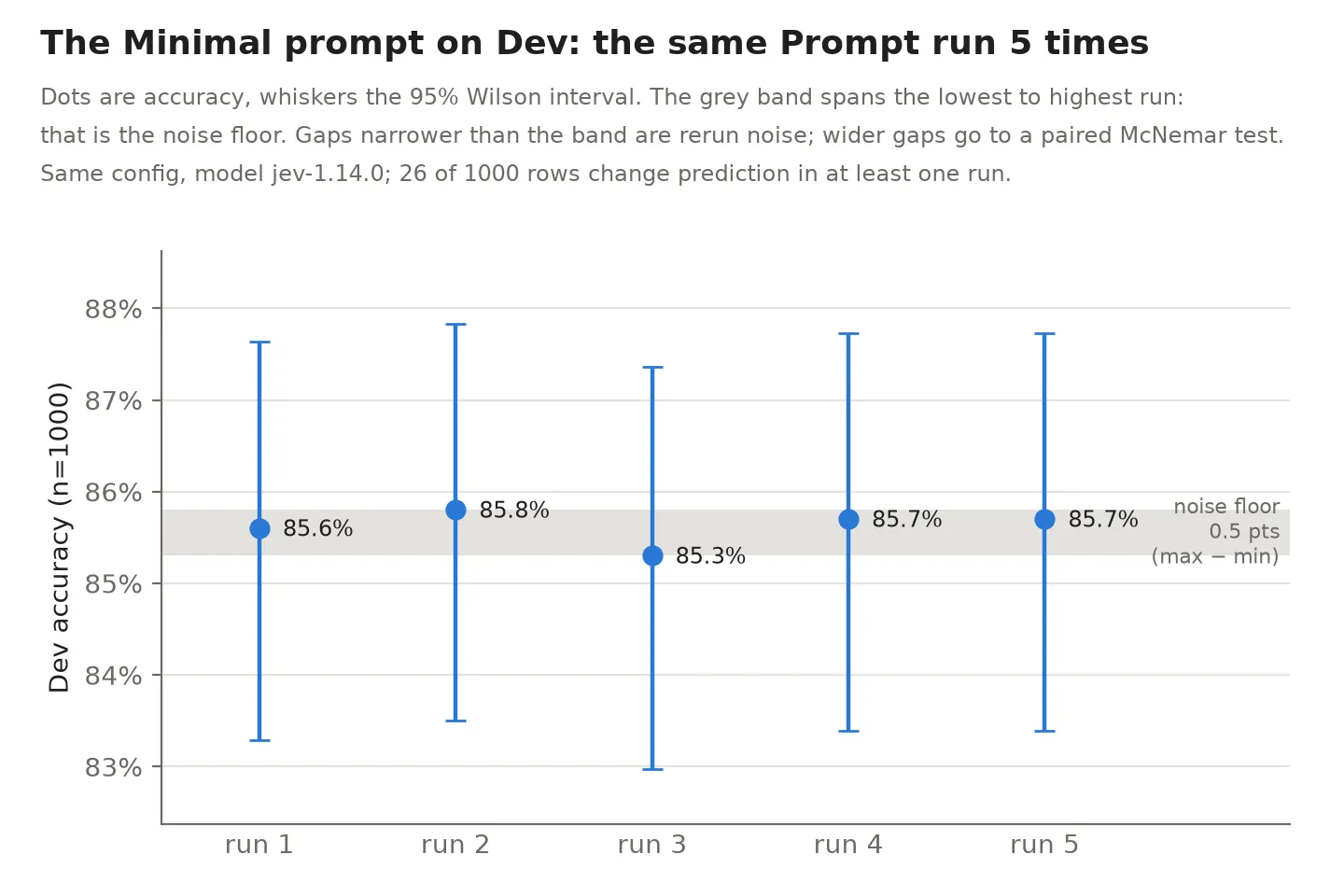
The grey band is about a ninth as tall as the Wilson whiskers. That difference ended up mattering more than the floor itself (more on that below).
The 26 questions that change
974 of the 1,000 questions got the same answer all five times. The other 26 move around.
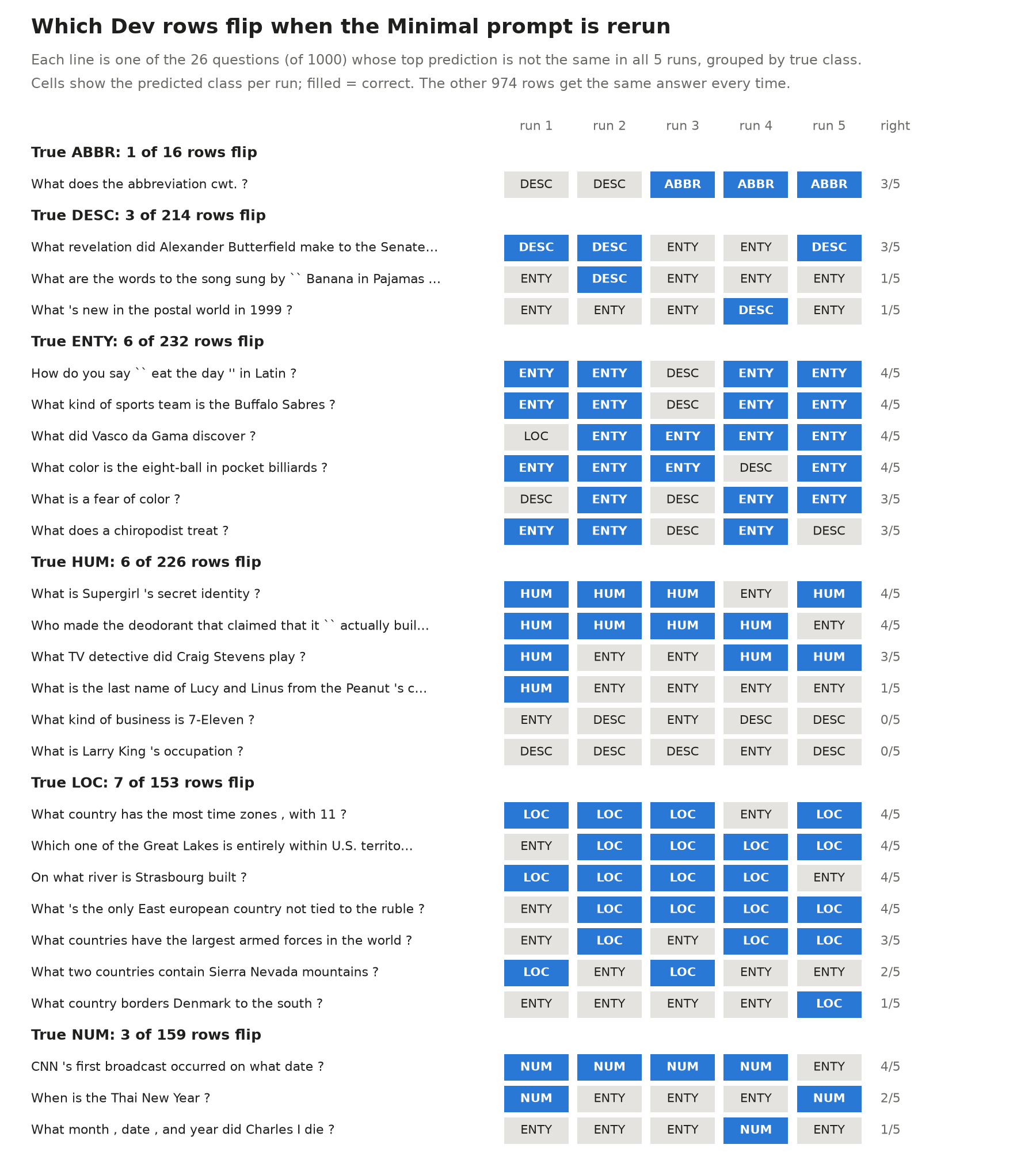
They’re the same ENTY problem from last time. 25 of the 26 have ENTY as one of their answers. “What country borders Denmark to the south ?” got ENTY four times and LOC once. “When is the Thai New Year ?” went NUM, ENTY, ENTY, ENTY, NUM. These questions sit on the line between “entity” and another class, and Jev can pick either side on a given run.
Two of them never matter for the score. “What is Larry King ’s occupation ?” and “What kind of business is 7-Eleven ?” flip between DESC and ENTY, and the right answer is HUM, so they’re wrong every time.
This gave me a way to check whether the 26 rows explain all of the wobble. Treat each flipping question as a five-sided die, with one face for each run and some of the faces marked “right”. “What country has the most time zones” was right 4 of 5 times, so it’s a die with 4 right faces, and each roll lands right with . Each die adds to the variance of the total, and the other 974 questions add nothing. Add it all up and the predicted standard deviation is 0.21 points, against a measured 0.19. With only five runs both numbers are rough, but they’re close enough that the 26 rows look like the whole story.
Two different kinds of noise
The last post put a Wilson interval of roughly ±2.2 points on 85.7%. The noise floor is 0.5. I’d been calling both of them “noise”, but they answer different questions.
The noise floor is what happens when you ask Jev the same 1,000 questions again. Only the borderline ones change. Five runs caught 26 of them, and more runs would probably turn up a few more.
The Wilson interval is a range for Jev’s accuracy on TREC questions in general. A different 1,000 might happen to have more easy questions or more ENTY traps, and that moves the score a lot more than rerunning does. So most of the interval is about how hard this particular sample happened to be, and on this Dev set it’s about nine times wider than the floor.
Comparing two prompts on the same questions
When I compare two prompts, they both answer the same 1,000 Dev questions. The McNemar test is built for that kind of paired data.
Split the questions into four groups: both prompts right, both wrong, only A right, only B right. The first two groups say nothing about which prompt is better, so McNemar ignores them. It only looks at the discordant questions, the ones where exactly one prompt got it right.
If the two prompts were equally good, each discordant question would be a fair coin flip between them. The p-value is the chance of a split at least as lopsided as the one you got, if it really were fair coins. With questions only A got right and only B got right:
where is the number of heads in fair coin flips.
I built a jevgym compare command that does this and tried it on the repeats. These are all the same prompt, so there’s nothing real to find. Run 3 against run 2, the widest pair, gives a 0.5-point gap with a 2 vs 7 split on the discordant questions:
Across all 10 pairs of repeats, two identical runs disagree on 9 to 15 questions, and none gets below (the smallest is 0.18). The test should still raise a false alarm about 1 time in 20, so ten clean pairs is reassuring but doesn’t prove much.
The repeats also show that any comparison starts with about a dozen discordant questions from rerun noise alone, before the prompts differ at all.
The rule I changed
My first version of the rule labeled each comparison in this order:
- If the gap is within the 0.5-point floor, it’s within noise floor.
- If McNemar’s , or the gap falls inside either prompt’s Wilson interval, it’s not yet resolved.
- Otherwise it’s resolved.
The Wilson part of step 2 turned out to be a problem. Say a new prompt fixes 20 questions Minimal got wrong and breaks 5 it got right. That’s +1.5 points, three times the floor, and McNemar gives . That’s strong evidence of a difference on these questions. But 1.5 is inside Minimal’s ±2.2-point interval, so the rule called it “not yet resolved”.
The interval is wider because most of it covers “how hard is this sample of questions”. In a paired comparison both prompts saw the exact same questions, so that part cancels, and requiring the gap to clear the interval counts noise the comparison already removed.
So I dropped it. Now, above the floor, McNemar decides on its own: is resolved, anything else is not yet resolved. I still print both Wilson intervals on every comparison. They just don’t decide the label anymore.
The floor step turns out never to change a verdict on its own. A 0.5-point gap means one prompt won 5 more discordant questions than the other. Even the most lopsided way to get there, 5 vs 0, gives , so McNemar would have called it not yet resolved anyway. What the floor step changes is the label, “within noise floor” instead of “not yet resolved”.
I’m keeping it anyway, because the two labels tell me different things. “Not yet resolved” means more data might settle it. “Within noise floor” means the gap is no bigger than what I get from rerunning the same prompt, so there’s nothing there to chase.
If I try lots of prompts against the same Dev set, though, some will clear by luck. At 5% per comparison, twenty comparisons would give about one fake win on average. That’s what the locked Test set is for: one run at the very end, on questions nothing was tuned on.
One question moved the log loss
Log loss charges , where is the probability Jev gave the right answer, and would cost infinity. So the score first raises any below a clip value up to that value. Last post used a clip of , where a question with costs 34.5. Across the five runs there were 34 or 35 of those, and that one extra question moved log loss by 0.030 (1.513 to 1.543). Jev rounds its probabilities to 0.01, so a 0 really means “below 0.005”. Clipping at 0.005 instead makes the same question cost , and log loss then moves by only 0.004 (0.516 to 0.520), about the same as Brier’s 0.003. From here on I’m reporting log loss at the 0.005 clip, so the 1.545 from the last post now reads 0.522. The strict number is still saved alongside it.
Next: the other baselines
Now the 85.7% has something to compare against. The next round runs the other baselines on Dev: the Hand-written prompt, the Naive Bayes prompt and the AI-written prompt. Each one gets compared against Minimal, on the same questions, with the 0.5-point floor and McNemar deciding what counts.
My guess: the AI-written prompt does best, and the Hand-written one comes close.